



Industry News










0102030405
Jutao Aerogel Hydrophobicity: The Ultimate Solution to Industrial Equipment Insulation Moisture Absorption Failure
2026-03-16
Decrypting Jutao Aerogel Hydrophobicity: How to Completely Solve Moisture Absorption Failure in Equipment Insulation?
Imagine you’re in an industrial plant in Northern Europe, where you’ve wrapped a multi-million-dollar production line in thick insulation. However, after a winter turns to spring, inspectors find water droplets condensed inside the insulation material, causing the insulation effect to plummet and even triggering corrosion of the equipment shell. Moisture absorption failure, a common yet tricky "invisible killer" in industrial insulation, not only causes a surge in energy consumption but also directly threatens production safety and equipment service life. If you’re a procurement decision-maker, this is no trivial matter. This article will deeply analyze how Jutao aerogel, with its excellent hydrophobicity, fundamentally solves this persistent problem, providing you with a professional and durable long-term insulation solution. Let’s start by understanding the essence of the problem.
The Root Cause of Moisture Absorption Failure: Why Are Traditional Insulation Materials "Afraid of Water"?
The accumulation of moisture inside equipment insulation layers, professionally known as "moisture absorption failure," is far more destructive than it appears on the surface. Traditional insulation materials, such as glass wool, rock wool, or some early silicate products, have a large number of open micropores or fiber gaps inside. These structures, like sponges, easily absorb water vapor from the air through capillary action. Once the ambient temperature drops below the dew point, water vapor condenses into liquid water inside the material.
The thermal conductivity of water (about 0.6 W/(m·K)) is more than 20 times that of air (about 0.026 W/(m·K)). This means that once the insulation layer gets damp, its overall thermal conductivity deteriorates sharply, commonly known as "insulation failure." More seriously, the long-term presence of liquid water will accelerate the electrochemical corrosion of metal equipment and pipelines (such as stress corrosion cracking caused by chloride ions), which is a major safety hazard in the chemical and energy fields. A real industry case: a coastal petrochemical enterprise once found extensive wall thickness reduction in carbon steel pipelines transporting high-temperature media during shutdown maintenance due to long-term dampness of the insulation cotton lining, eventually having to spend millions of yuan on partial replacement and bear huge losses from unplanned production suspension.
So, can a simple waterproof outer layer solve the problem?
This is a common misunderstanding. Waterproof outer layers (such as aluminum sheets, color steel plates) mainly prevent liquid water (rainwater) from invading, but cannot block the pervasive water vapor. Under day-night temperature differences or seasonal changes, water vapor can still penetrate into the insulation layer and condense on the cold interface, making its hazards more concealed.
The Science of Hydrophobicity: The "Water-Repellent" Core of Jutao Aerogel
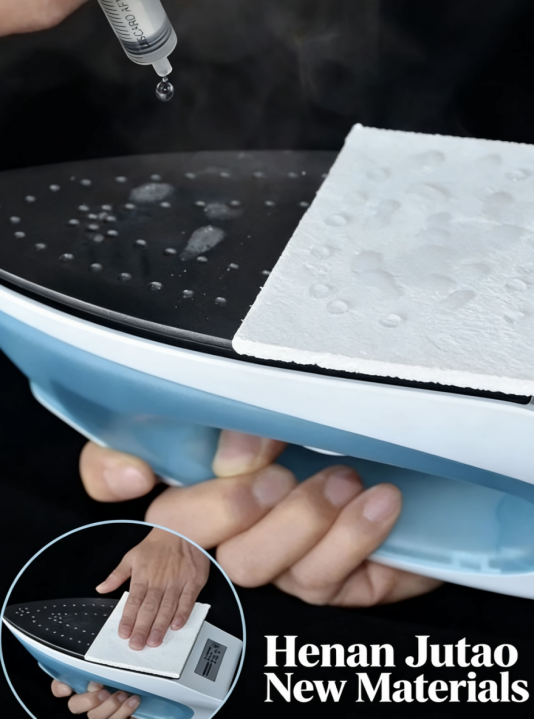
To truly be "immune" to moisture absorption, the material itself must be hydrophobic. The hydrophobicity of Jutao aerogel is not a post-added coating, but originates from its unique nano-network structure and surface chemical modification.
Structurally, Jutao aerogel is composed of cross-linked silica nanoparticles, forming a three-dimensional nano-porous network. Its porosity is extremely high (up to more than 90%), but the pore size is mainly between 20-50 nanometers, which belongs to the typical mesoporous category. This extremely fine pore size first greatly increases the threshold of capillary condensation pressure of water, making it difficult for liquid water to invade spontaneously. More importantly, through our process, stable hydrophobic groups (such as methyl-Si-CH3) are grafted on the surface of the silica framework. These groups are like putting a hydrophobic coat on each "nano-framework," making the material surface energy extremely low, with a contact angle with water usually greater than 150 degrees, showing the "lotus leaf effect."
This means that not only liquid water droplets will roll off its surface, but even water vapor molecules are difficult to adsorb and condense on the pore wall surface. Tested by third-party authoritative institutions, the hydrophobicity rate of Jutao aerogel can be continuously maintained above 99%. Even after long-term immersion or in high-temperature and high-humidity environments, its mass moisture absorption rate is less than 1%, far better than the national standard. In the BOG recondenser insulation project of a large LNG receiving station in southern China, the project party conducted a comparative test of various materials. After two years of operation in the coastal high-salt spray environment, obvious rust had appeared on the outer wall of the equipment under the traditional material insulation layer, while the insulation structure using Jutao aerogel was still dry inside during tank opening inspection, the metal surface was as bright as new, and the insulation effect attenuation rate was less than 3%.
From Laboratory to On-Site: Engineering Practice Advantages of Jutao Hydrophobic Aerogel
Understanding the principle, let’s see how it solves specific problems in actual engineering. For purchasers and end-users, performance ultimately translates into reliability and economic benefits.
First, it achieves full-life-cycle moisture protection. Hydrophobicity runs through the entire process from warehousing, transportation, construction to long-term operation. During the construction phase, especially in the plum rain season or humid underground pipe corridors, traditional insulation materials need to wait for a dry environment to be constructed; otherwise, they become "wet cotton-padded jackets" as soon as they are installed on the pipes. Jutao aerogel blankets or boards, however, are not subject to this restriction. Even if the surface gets wet, the performance remains unchanged after wiping, which greatly shortens the construction period and reduces project risks caused by uncertain weather. An international engineering company used this feature in a thermal power plant project constructed in Southeast Asia, seizing the key insulation construction window during the rainy season.
Second, it simplifies the insulation system design. For low-temperature cold insulation equipment (such as LNG pipelines at -160°C), preventing the infiltration of external high-temperature and high-humidity air leading to ice damage is the core. The traditional scheme requires a complex multi-layer structure of "moisture-proof layer - insulation layer - vapor barrier layer," which has extremely high requirements on construction accuracy. Any improper joint treatment will become a hidden danger. With Jutao aerogel, since it is inherently hydrophobic and itself an efficient vapor barrier, the system structure can be simplified, reducing failure points caused by too many layers and complex joints, and improving the reliability of the entire system.
Users often ask: "It is so hydrophobic, will it fail when exposed to open flames or high temperatures if used on high-temperature pipelines?"
This is a very good safety question. When the hydrophobic groups of Jutao aerogel are continuously exposed to an environment above 350°C, they will gradually undergo pyrolytic oxidation, and the hydrophobicity will decrease slowly. Therefore, for high-temperature pipelines exceeding 350°C, we usually recommend a composite structure: a ceramic fiber layer that is high-temperature resistant but may be slightly hydrophilic is used on the hot surface close to the metal, while Jutao aerogel is used on the outer surface as the main insulation and waterproof vapor barrier layer. This can not only withstand high temperatures but also ensure that the outer layer most prone to moisture remains dry for a long time, which is an economical and efficient combination scheme.
Return on Investment (ROI) Analysis: Paying for Long-Term Reliability
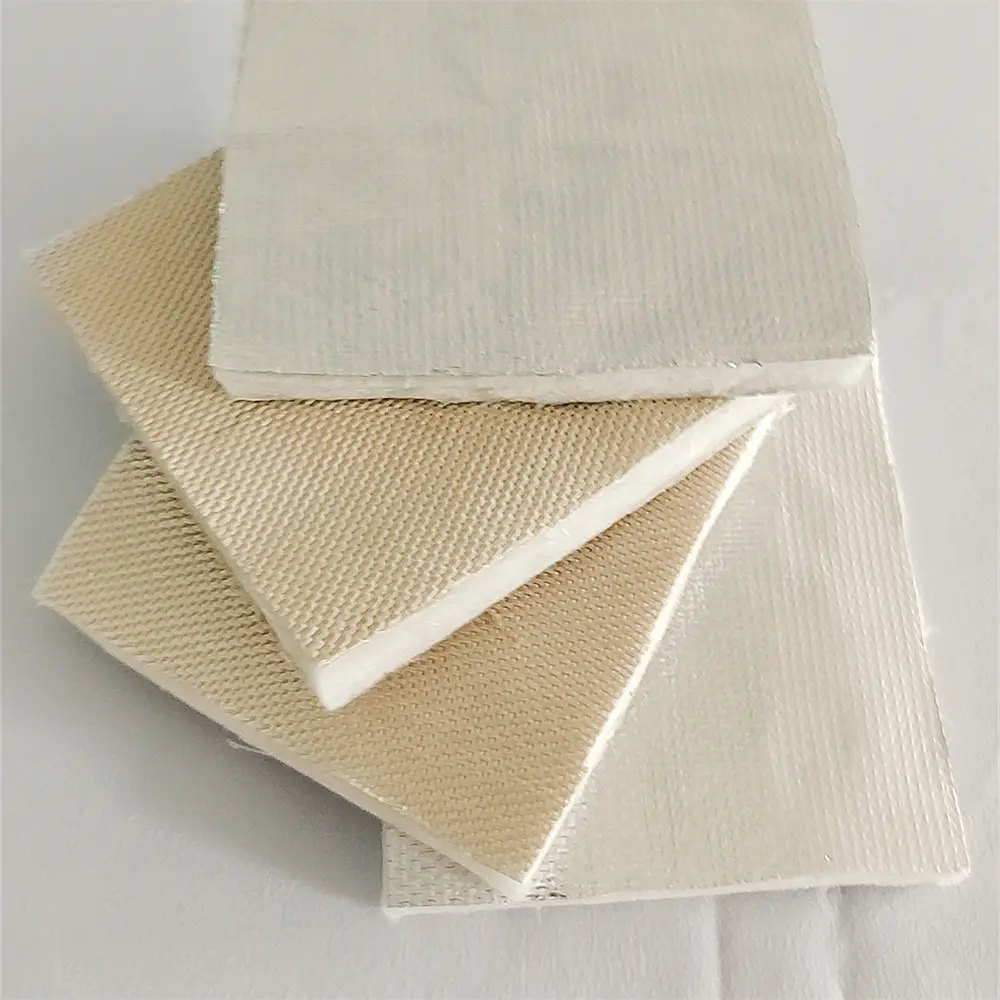
The choice of any new material will eventually return to cost-benefit analysis. At first glance, the unit price of Jutao aerogel is higher than that of traditional insulation materials. But decision-makers should calculate the Total Cost of Ownership (TCO).
Energy-saving benefits: Due to its constant dryness and extremely low thermal conductivity (about 0.018 W/(m·K) at room temperature), the energy-saving effect is stable throughout the service life. Taking a medium-temperature steam pipeline operating 8000 hours a year as an example, compared with traditional materials whose performance drops by 50% after getting damp, the annual energy cost saved by using Jutao aerogel can usually offset the material price difference within 2-3 years.
Maintenance and replacement costs: It eliminates the costs of regular inspection and maintenance, replacement of insulation materials, and treatment of equipment corrosion caused by moisture absorption failure. Especially in areas with narrow space and difficult maintenance (such as offshore platforms, deep pipe corridors), installing a reliable product at one time is far more valuable than the material itself.
Safety and avoidance of production suspension losses: This is crucial for the process industry. An unplanned production suspension or leakage accident caused by corrosion may result in losses of millions or even tens of millions of yuan. The long-term and reliable protection provided by hydrophobic aerogel is an important investment in production continuity and safety.
A pharmaceutical enterprise located in a rainy area, after replacing all the insulation of the hot and humid steam pipelines in its clean workshop with Jutao aerogel, not only improved the workshop environment because there were no more "wet" insulation layers, but also reduced its annual steam energy consumption by about 15%, and it is expected that the overhaul cycle of the insulation system will be extended from 3-5 years to more than 10 years, with significant comprehensive economic benefits.
Conclusion
Moisture absorption failure is a "chronic disease" of industrial insulation, and relying on external waterproofing only treats the symptoms but not the root cause. Starting from the origin of materials science, Jutao aerogel cuts off the path of water vapor invasion and condensation by endowing the material itself with excellent and long-lasting hydrophobicity, thus providing a once-and-for-all dry protection for equipment. For cross-border purchasers and end-users who pursue long-term stable operation, focus on the whole-life-cycle cost and production safety, choosing an insulation solution that eradicates the hidden danger of moisture absorption is not only a technical upgrade but also a wise strategic investment. When you evaluate an insulation project next time, you may wish to take the material’s "hydrophobicity" as a key decision index—it may be the most critical decryption key to ensuring the long-term effectiveness of your investment.
FAQ
Q1: Is the hydrophobicity of Jutao aerogel permanent? How does it perform under long-term outdoor exposure?
A: Its hydrophobicity comes from chemically bonded hydrophobic groups, which are chemically stable. Within the conventional atmospheric environment and temperature range (-200°C to +250°C), the hydrophobicity is permanently effective. For long-term outdoor UV irradiation environments, we recommend installing a standardized protective outer layer (such as aluminum sheets, galvanized plates). This not only protects the aerogel but also is a standard practice for all insulation materials, ensuring that its superhydrophobic performance can be maintained for more than 20 years.
Q2: For existing insulation systems that have been damp, can Jutao aerogel be directly wrapped outside for renovation?
A: Not recommended. Before renovation, the failed wet insulation layer must be removed, and the equipment surface must be derusted, cleaned, and dried. Directly wrapping new materials outside the damp old insulation layer cannot solve the internal water accumulation and corrosion problems, and moisture may migrate at the interface between old and new materials. The correct approach is to completely replace it and use the excellent performance of Jutao aerogel to build a new dry insulation system.
Q3: In oily environments (such as oil refineries), will hydrophobic aerogel fail due to oil immersion?
A: No. Jutao aerogel is "hydrophobic and oleophobic," with a large contact angle with common mineral oils and good resistance to oil immersion. In environments with occasional oil mist or slight splashing, the performance is not affected. However, if it is soaked in a large amount of heavy oil for a long time, it still needs to be cleaned in time. External cleaning and maintenance of any insulation material are necessary.
Meta Description
Deeply decrypt how Jutao aerogel hydrophobicity fundamentally solves the problem of moisture absorption failure in industrial equipment insulation. From principles and cases to ROI analysis, this article provides a radical solution for cross-border purchasers and B2B customers, ensuring long-term dry insulation, energy-saving stability, and eliminating corrosion hazards. Get a professional solution immediately and choose one-stop protection for your equipment.
Keywords
aerogel hydrophobicity, insulation moisture-proof, equipment insulation failure, Jutao aerogel, industrial insulation materials