



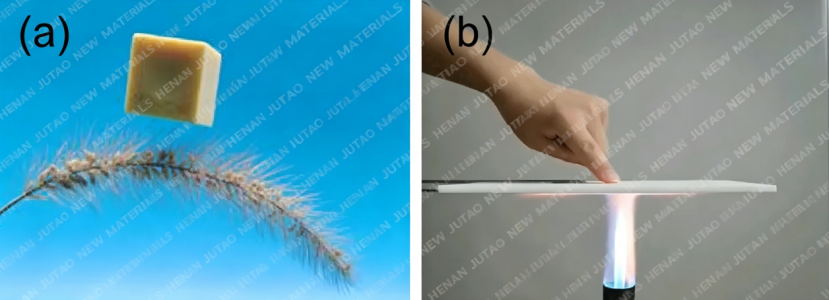









Flexible Aerogel Factories Principle of Fiber-Reinforced Aerogel Insulation Sheets
Driven by the global energy crisis and the accelerating transition toward low-carbon development, high-performance thermal insulation materials have become a key enabler for energy efficiency across multiple industries. Conventional insulation materials—such as glass wool, rock wool, and polyurethane foam—are able to meet basic thermal requirements, but they face clear limitations in terms of insulation efficiency, lightweight design, and high-temperature resistance.
As a new generation of nanoporous thermal insulation materials, fiber-reinforced aerogel insulation sheets exhibit disruptive performance advantages due to their unique structural design and thermal insulation mechanisms. They are increasingly being adopted in high-end applications, including new energy systems, aerospace engineering, and electronic equipment.
- Core Thermal Insulation Mechanism
Multidimensional Heat Transfer Suppression Enabled by Nanostructure
The superior performance of fiber-reinforced aerogel insulation sheets originates from the strong coupling between their microstructure and heat-transfer mechanisms. Their solid framework consists of nanoscale particles forming a continuous three-dimensional network, with an exceptionally high porosity ranging from 80 % to 99 %. The pore sizes are predominantly distributed between 20 and 50 nm, which is smaller than the mean free path of air molecules under ambient conditions (approximately 70 nm).
Within this structure, all three primary heat-transfer modes are simultaneously suppressed:
- Solid-State Conduction
The tortuous pathways and extremely small cross-section of the nanoscale skeleton significantly increase resistance to heat flow through the solid phase.
- Gaseous Conduction
Gas molecules trapped inside the nanopores are unable to collide freely, leading to a substantial reduction in heat transfer via gas diffusion.
- Radiative Heat Transfer
The incorporation of infrared opacifiers such as titanium dioxide (TiO₂) and silicon carbide (SiC) enables effective absorption and reflection of infrared radiation, which becomes increasingly dominant at elevated temperatures, thereby further limiting heat transfer.
The synergistic suppression of these three heat-transfer pathways allows fiber-reinforced aerogel insulation sheets to achieve an ultra-low thermal conductivity of below 0.015 W/(m·K)—significantly outperforming conventional insulation materials, such as glass wool (typically around 0.035 W/(m·K)).
Jutao Environmental Technology — Specialists in Aerogel Material Solutions
Stay connected with us for the latest updates, industry insights and application solutions in the aerogel sector.