


A nanofiber aerogel with multiple functions of wave absorption and heat insulation
1.Background Introduction
With the advancement of aviation technology, hypersonic aircraft are increasingly being developed for military applications. Aircraft components are subjected to high temperatures during ultra-high-speed flight. Simultaneously, stealth technology is crucial for avoiding detection by enemy radar. Therefore, developing multifunctional materials with electromagnetic wave attenuation and thermal insulation capabilities is of great significance to scientists and engineers. Aerogels are porous materials composed of microporous solids with an air-gas phase. Their unique interconnected network structure exhibits significant characteristics such as low density and large specific surface area, playing a key role in electromagnetic wave attenuation and thermal insulation. Li and colleagues prepared an organic-inorganic aerogel material with considerable electromagnetic wave attenuation and thermal insulation properties. Liang et al. prepared a hybrid aerogel by combining MXene and graphene, achieving impressive results. Despite the remarkable performance of these aerogels, their tendency to collapse at high temperatures hinders their practical applications.
2.A Glimpse of Achievements

Recently, the team led by Zhang Liying at Donghua University has made significant progress in preparing porous PI aerogels with low volume shrinkage. They achieved control over the hierarchical pore structure of PINF aerogels using ultrasonic freeze-drying. The hierarchical microporous structure is formed by a combination of interconnected primary pores resulting from the removal of ice crystals from the PINF mesh and secondary pores in the PNIF mesh. The unique porous 3D network of the nanofiber aerogel provides excellent impedance matching characteristics and enhances multiple reflections and scattering of electromagnetic waves. Simultaneously, polar functional groups and defects on MXene induce dipole polarization, and the heterogeneous interface between PINF and MXene enhances interfacial polarization. Therefore, the MXene/PINF aerogel exhibits highly efficient microwave absorption performance, displaying a minimum reflection loss of -37.9 dB and an effective absorption bandwidth (EAB) of 3.3 GHz. Furthermore, the MXene/PINF aerogel also exhibits low thermal conductivity and excellent compressibility, making it suitable for use in special service environments. The research findings, titled "A strategy to fabricate hierarchical microporous architecture of polyimide nanofibrous aerogels with efficient electromagnetic wave absorption and thermal insulation," were published in 《Composites Part A》.
3.Illustrated Guide
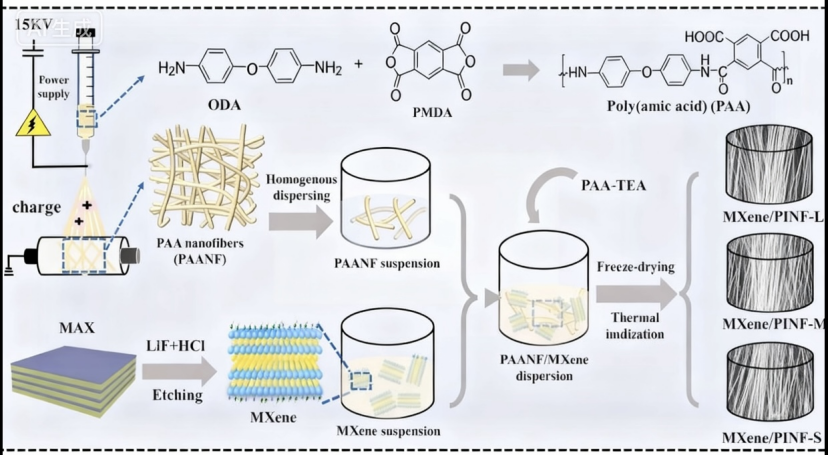
Figure 1. Schematic diagram of the preparation process of MXene/PINF aerogel.
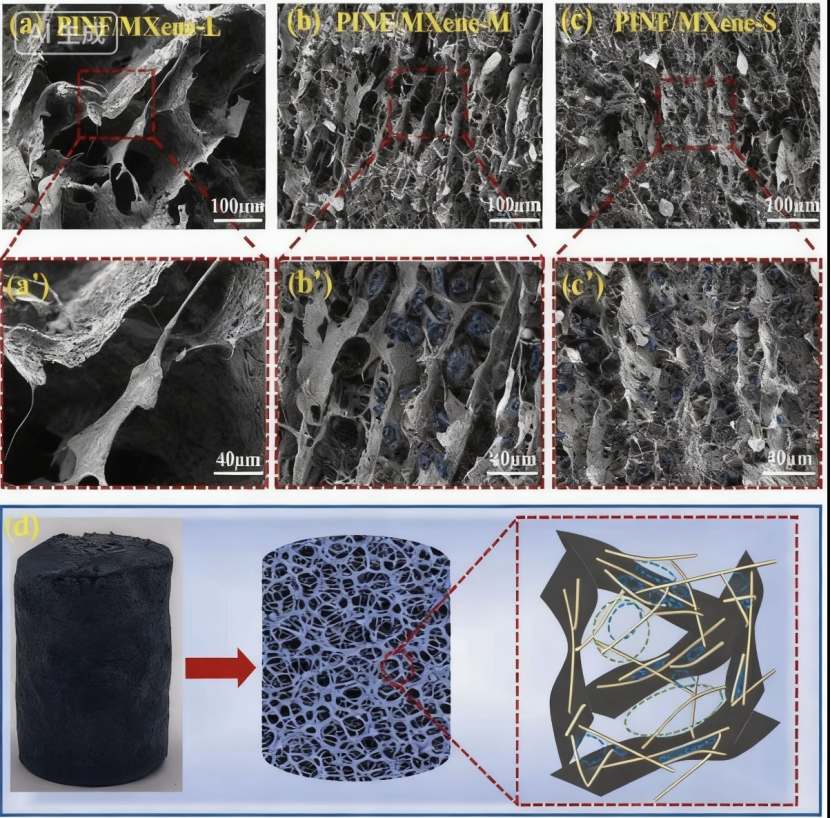
Figure 2. SEM images of (a, a') MXene/PINF-L, (b, b') MXene/PINF-M and (c, c') MXene/PINF-S; (d) Schematic diagram of the multi-level microporous structure.
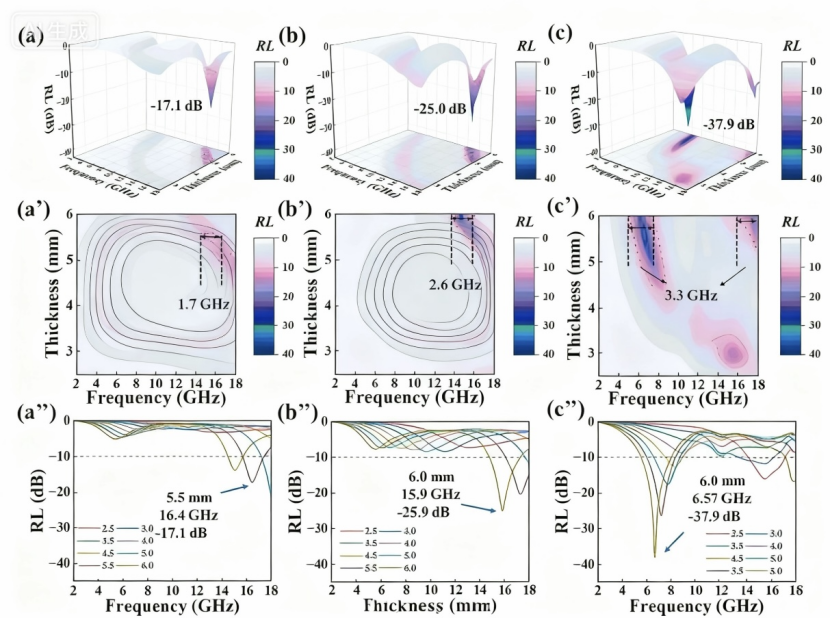
Figure 3. (a–c) 3D plot, (a′–c′) 2D contour RL plot, and (a″–c″) RL frequency curves for MXene/PINF-L, MXene/PINF-M and MXene/PINF-S at different thicknesses.
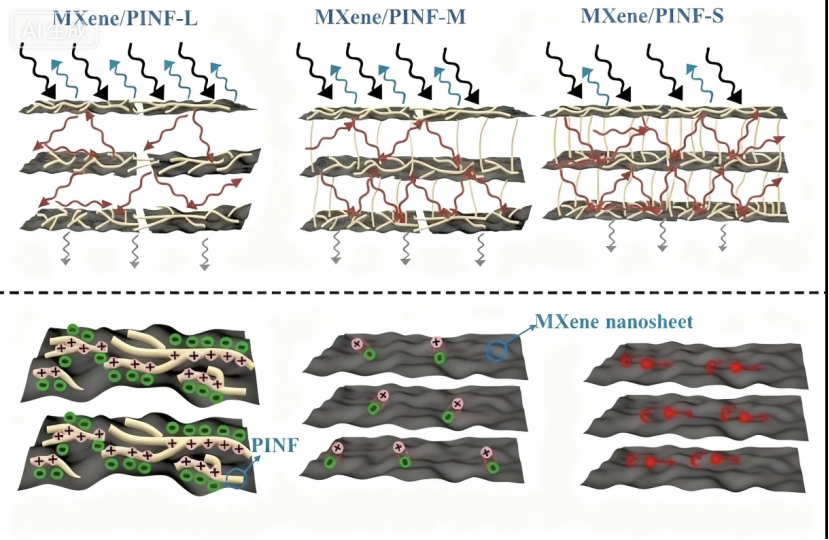
Figure 4. Electromagnetic wave absorption mechanism of MXene/PINF aerogel.
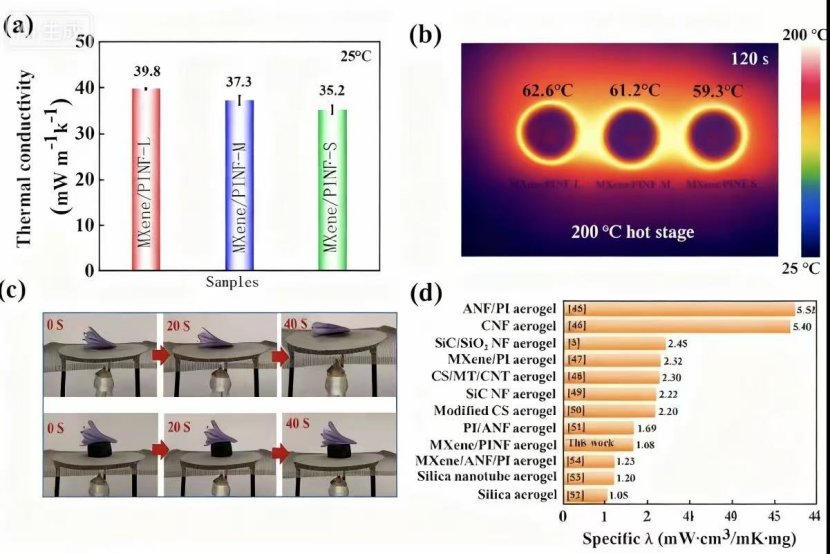
Figure 5. (a) Thermal conductivity of MXene/PINF aerogel at ambient temperature; (b) Infrared image of MXene/PINF aerogel; (c) Photograph of African agapanthus heated with an alcohol flame; (d) Comparison of thermal insulation properties of different aerogels (ANF: aramid nanofibers; NF: nanofibers; CS: chitosan; MT: montmorillonite; CNT: carbon nanotubes; CNF: cellulose nanofibers).